


Where Design Meets Soul: The Art of Ipan Noya
Step inside Ipan Noya in Santa Tecla, where owner and designer Edgar Marroquín weaves family history, Nawat roots, and mixed-media art into luxury hospitality.
ART
The NEW EL SALVADOR staff writer
7/27/20267 min read
Where Design Meets Soul: The Art of Ipan Noya
Most hotels acquire art after the architecture is finished.
At Ipan Noya, the art grew out of the same ideas that shaped the building itself.
The concrete walls, native woods, filtered light, handmade surfaces, poetry, textiles, and oversized canvases are not separate decorative decisions. Together, they tell a story about memory, family, intimacy, and what it means to make someone feel cared for.
Every major artwork in the hotel was created on-site by Ipan Noya owner and designer Edgar Marroquín. After more than two decades working in interior design and staging in the United States, Marroquín returned to his family’s Salvadoran roots carrying a design language shaped by two seemingly opposite instincts: restraint and sentiment.
The architecture is intentionally quiet. The art is where the personal story begins to surface.
A Hotel Named for a Great-Grandmother: The Nawat Roots of Ipan Noya
Even the name of the hotel begins with family.
Ipan Noya refers to “great-grandmother” in Nawat, and for Marroquín, that idea became more than a name. It became a model for hospitality.
“A great-grandmother can love an entire family completely, but she doesn’t care for every person in exactly the same way. She understands what each one needs.”
That distinction became central to Ipan Noya.
A business traveler arriving late at night may value efficiency, quiet, and privacy. A Salvadoran family returning from abroad may be looking for connection, familiarity, and a sense of home. A couple spending a weekend in the city may want something entirely different.
The care is equal. The expression of that care changes.
That same philosophy appears in the art. Rather than filling the hotel with anonymous decorative pieces, Marroquín created work rooted in specific memories, relationships, materials, and places.
Much of that creative inheritance begins with his mother. She is a published poet, now completing her second collection, and Marroquín credits her with much of his own sensitivity to texture, composition, and detail.
“She sees things closely,” he says. “I think I inherited that from her.”
At Ipan Noya, their creative worlds eventually began to overlap. Her poetry became material. Family memories became form. Hotel linens became sculpture.
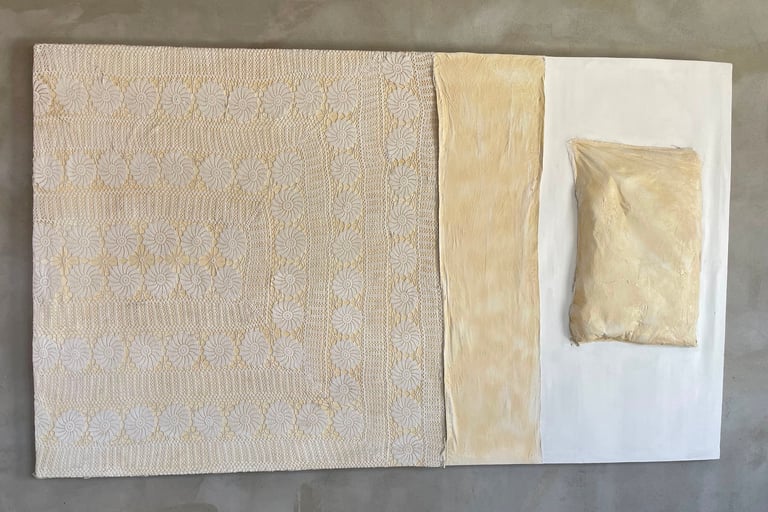
Cama de la Abuela
The most directly nostalgic piece is Cama de la Abuela.
Its starting point is a familiar image across generations: the grandmother whose bed was always carefully made. There was often lace, crochet, or embroidery—textiles that had been washed hundreds of times and somehow remained precious.
“These women worked incredibly hard,” Marroquín says. “There wasn’t anything precious about their lives in the modern luxury sense. But there was enormous pride in how things were cared for.”
That idea interested him more than nostalgia alone. The piece combines aged, traditional lace with the crisp visual language of contemporary hotel bedding. One represents domestic memory; the other represents professional hospitality. Placed together, they collapse the distance between grandmother’s house and boutique hotel.
That relationship gets close to the central idea behind Ipan Noya: luxury does not have to mean extravagance. Sometimes it means that someone anticipated what you needed and prepared a place for you before you arrived.
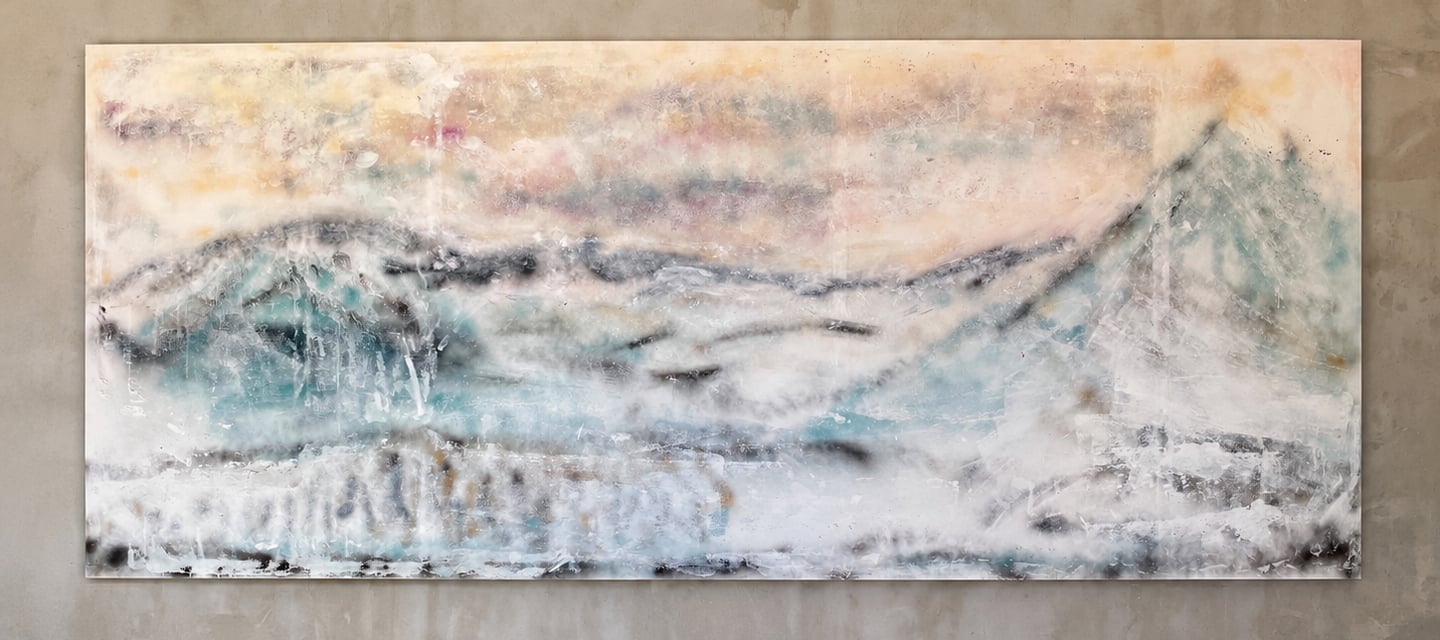
Atardecer Tecleño: Capturing Santa Tecla’s Landscape and Volcano Views
While the Bed Series turns inward, Atardecer Tecleño looks outward.
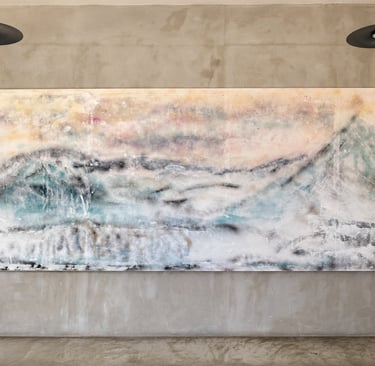
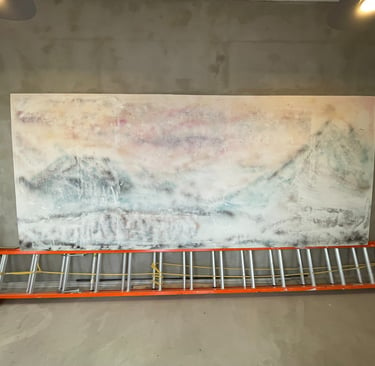
The enormous 12-foot canvas near the hotel entrance is rooted specifically in Santa Tecla. The city’s light changes quickly in the late afternoon—mountain silhouettes soften, mist moves across the valley, and colors appear and disappear within minutes.
Rather than paint the landscape literally, Marroquín tried to reproduce the sensation of watching it shift.
The piece began with spray paint used to establish the mountain geometry. Layers of latex and oil followed. Areas were built up, scraped away, blurred, and repainted. The result sits somewhere between landscape and memory. Forms appear, dissolve, and reappear.
The painting’s scale is important because the actual landscape outside Ipan Noya is large. The work was never intended to function as a small decorative interpretation of Santa Tecla. It needed to compete with the view.
Guests encounter the canvas as they enter the property. When they turn back toward the exterior, the real mountain horizon appears beyond it. One is constructed; one is changing by the minute. The conversation between them is intentional.
Why the Art Is Mostly Quiet
There is another characteristic connecting the works: very little of the art demands attention through bright color or obvious symbolism. Much of it is white, cream, gray, faded plum, pale blue, or muted earth tones.
That restraint reflects the architecture.
Ipan Noya uses concrete extensively, but the goal was never industrial severity. The unfinished surfaces provide a neutral field where texture, wood, fabric, art, people, and changing daylight can become more visible.
The artwork follows the same logic. A fold of fabric becomes important. A shadow becomes important. The edge of a pillow becomes important. So does the difference between something handmade and something manufactured.
The hotel reveals itself gradually. That is deliberate.
A Different Definition of Luxury
The art also helps explain Ipan Noya’s broader definition of luxury.
It is not primarily about ornament, marble, or spectacle. It is about thought.
Someone made the artwork.
Someone selected the wood.
Someone shaped the plaster.
Someone considered where the light would fall.
Someone thought about the person who would eventually sleep in the room.
That accumulation of decisions creates an environment that feels personal without becoming overly precious.
For Marroquín, that distinction comes directly from his years as a designer. “Good design isn’t really about objects,” he says. “It’s about how someone feels in the space.”
At Ipan Noya, the artwork makes that philosophy visible.
The Hotel as an Ongoing Canvas
The collection is not intended to feel finished. Ipan Noya is still young, and Marroquín sees the hotel as an evolving creative environment rather than a completed installation.
New pieces can appear. Poetry can enter other spaces. Materials can be reconsidered. The relationship between the hotel and Musæ, its rooftop lounge, can continue to expand.
That openness may ultimately be the most personal aspect of the property. Ipan Noya was not created by separating hospitality, architecture, art, family, and memory into different categories. They were allowed to overlap.
The result is a hotel where the artwork is not something guests simply pass on the way to their rooms. It explains why the rooms, and the hotel around them, exist in the first place.
Experience the Space in Person
The art at Ipan Noya is an open invitation to slow down, notice the details, and feel at home in Santa Tecla.
Whether you are visiting for a quiet getaway, returning home to El Salvador, or gathering for sunset cocktails at Musæ Rooftop, we invite you to experience the story firsthand.
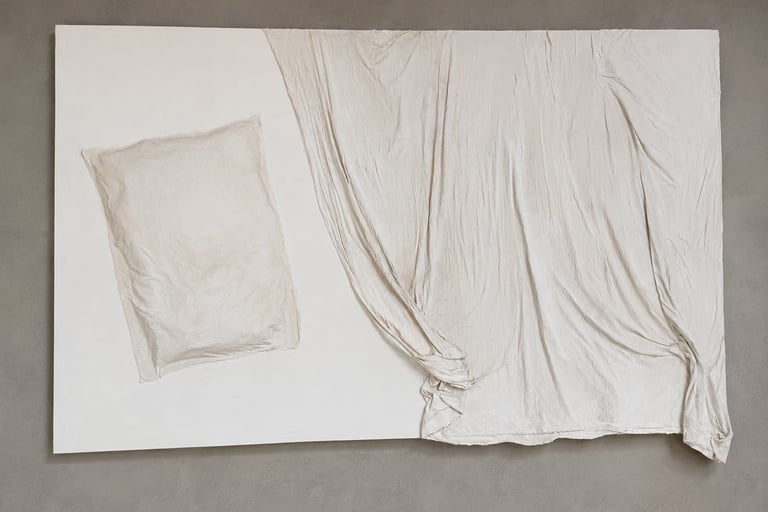
The clearest expression of this is the Bed Series.
Three large mixed-media works reinterpret the bed, perhaps the most ordinary object in a hotel, as something emotional and deeply human.
A hotel bed is usually presented as perfection: smooth sheets, aligned pillows, untouched surfaces. Marroquín was more interested in what happens before and after that perfection.
Beds hold sleep, illness, sex, grief, solitude, routine, childhood, marriage, exhaustion, and recovery. They are among the most private spaces in our lives, yet in a hotel they are also temporary.
That contradiction became the foundation of the series.
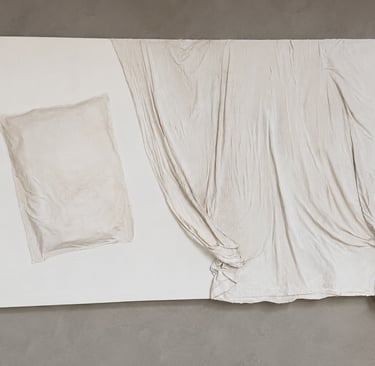
The works were constructed on oversized custom canvases using actual fabrics, lace, bedding, plaster, industrial adhesive, and drywall compound. Pillows and linens were saturated and shaped by hand until soft materials became permanent sculptural forms. The process took approximately three weeks.
Marroquín worked on all three pieces simultaneously with his general manager, while his mother helped with some of the finer textile work. What began as artwork about beds quietly became another family collaboration.
The Bed as Portrait: Contemporary Mixed-Media Art in Santa Tecla
La Cama Vacía
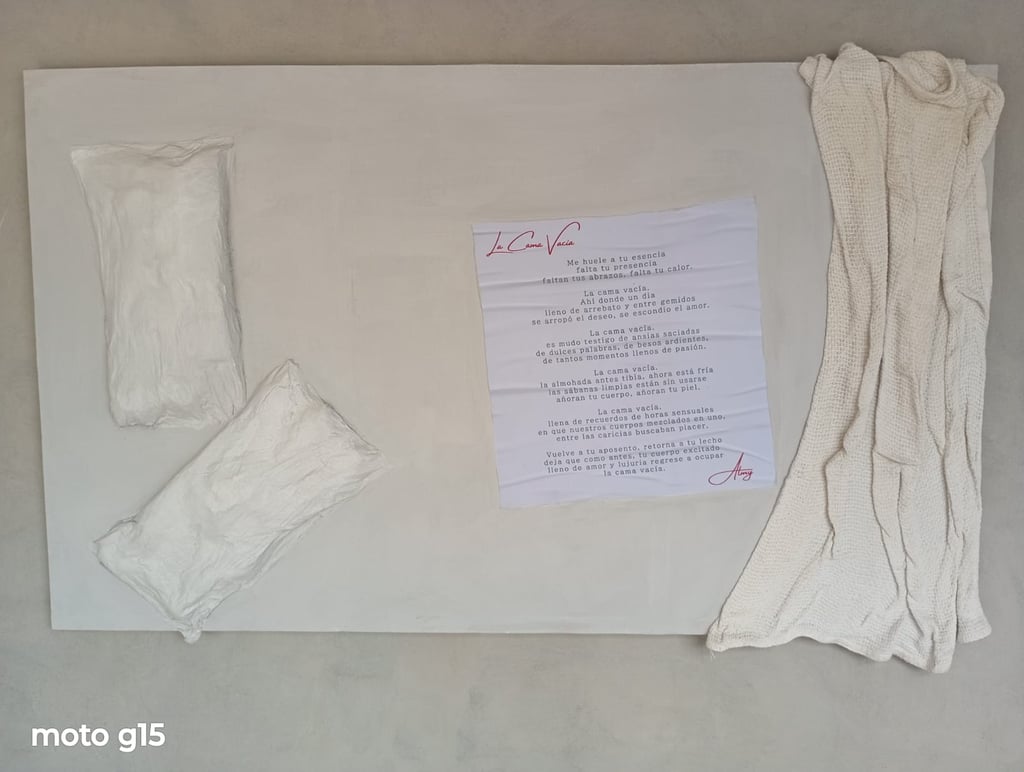
La Cama Vacía moves into much more intimate territory.
The work was inspired by a poem written by Marroquín’s mother and incorporates the poem directly into the artwork. Here the bed is no longer orderly—the visual language suggests aftermath.
Pillows are displaced. Fabric falls away from the composition. The bed appears to hold the physical evidence of something that has already happened. The subject is absence, but the absence feels charged.
“It’s the moment after passion,” Marroquín says. “The person is gone, but the room still knows they were there.”
“Literature becomes linen. The mother’s words and the son’s visual language occupy the same surface.”
The poem is not displayed beside the artwork like a museum label. It becomes part of the bed itself, printed onto fabric and absorbed into the physical composition. It is one of the clearest examples in the hotel of how personal history was allowed to enter the architecture without becoming sentimental decoration.
La Cama Sin Hacer
La Cama Sin Hacer is quieter. There is no explicit narrative. A pillow. Sheets pulled and gathered. An unfinished gesture.
The power comes from what is missing. Who slept there? Did someone leave in a hurry? Are they coming back? Was there one person or two? Nothing resolves the story.
That ambiguity matters.
An unmade bed is one of the most ordinary scenes imaginable, but it is also strangely revealing. Making the bed is the moment when private disorder is erased. Leaving it undone preserves evidence of the person who was there.
In a hotel, where housekeeping restores rooms to anonymity every day, the image becomes even more resonant. For a brief period, every guest changes the room. Then almost every trace disappears.
La Cama Sin Hacer freezes the moment before that erasure.
Reservations
+503 7290-1800
info@ipannoya.com
8 Calle Ote. & 15 Avenida Sur, Santa Tecla, La Libertad Sur


Information